
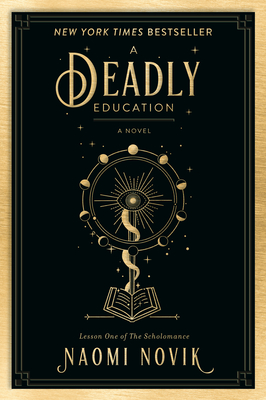
At the center of the story is a magical school. If you’re thinking about Hogwarts, this is nothing like that. There are no teachers, no holidays and the school kind of tries to kill the students. So why enroll? In this world, magical children are in danger from monsters everywhere. Till they grow old enough and skilled enough to be able to handle themselves, the school acts as a safehouse but still cannot keep all of the monsters out.
Our protagonist El, a cynical snarky loner, is “The One”. No, not the chosen one who can bring world peace, but the one who has it in her to destroy everything. Her being half Indian and speaking Indian languages (though I don’t speak any of the languages she does) is what made me give this book a try. Was I disappointed when I didn’t see the Indian representation I hoped for? Yes. Am I offended that its almost a bait like a few book-influencers say it is? No, because nowhere is the diversity advertised.
Writing style:
This was a quick and unputdownable read for me because I’ve developed a liking for info-dumping stories these days. To give you an example, let’s say our characters encounter a monster. In the middle of an action scene, there would be a couple of pages about the monster and some history about it before we get back to the action. I found this okay because I was quite intrigued about the world, but some may not like this style.
Likes and Dislikes:
+ Intriguing premise with original world-building
– The setting raises some questions which will hopefully be answered in the next book
+ Diverse characters
– If I have to nitpick, diversity feels slapped in for selling point
+ Independent, strong, savage MC with a sarcastic remark ready at all times
– El is a loner and basically mean to everyone when it’s common sense to make friends who will look out for you in such a setting. Interesting character but desperately needed some development by the end of the book.
+ Well written side characters. Considering that most of this book was to explain the world-building and El’s thoughts, it is understandable that we get to see very little about the other characters and yet the author managed to make them memorable.
– Most of the time is spent in the world-building and then the book ends in a mini-cliffhanger. This could have been a single big book or a duology instead of a trilogy.
Overall, I enjoyed this book and am waiting to read the next books to see character development and get some answers.
If you liked Harry Potter but wanted higher stakes:
This book reminded me of Harry Potter but is much more serious for the following reasons:
- At Hogwarts, the adults are the safety net. The dangers are real but the book arranges for them to be survivable. At the Scholomance, the adults are the business model. There are no teachers. The school was built by the enclaves, funded by the enclaves, and runs on the labour of students who have no enclave to go home to. When a student dies, the institution does not mourn — it recalculates.
- Harry is protected by the plot; El is endangered by hers.
- In Harry Potter, friendship is the moral centre from page one. In the Scholomance, alliances are literally about survival.
In general, these are the three rules of a higher-stakes school book:
- The system is the villain. There is a monster to fight, but the thing that produces the monsters is a structure, and the characters have to decide whether to survive inside it or break it.
- Death is permanent. No resurrection, no last-minute healer, no “she’s only mostly dead”. When someone goes, the book keeps the hole where they were.
- Adults are absent or complicit. Not evil, necessarily — just not coming to help.
A Deadly Education passes all three.
If what you loved about Harry Potter was the warmth, this will feel cold. There is no whimsy, no feast in the Great Hall, no owl post. If what you loved was the system, the rules, the map of a school you could learn, this may be for you.
Books like A Deadly Education
Five to read next
- Vita Nostra — Marina and Sergey Dyachenko. The closest thing to the feeling of this book: a Soviet magical institute that tests students to the point of destruction, with a system you learn by surviving it. Stranger, colder, and unforgettable. Start here if A Deadly Education left you wanting a school that genuinely uses people up.
- The Magicians — Lev Grossman. Brakebills, and the anti-Hogwarts argument made at full length: what if the school was real, and it made you miserable? Read it if El’s voice was the part you liked; be warned that Grossman’s characters are harder to love than Novik’s.
- The Poppy War — R. F. Kuang. School first, then war, and the stakes stop being metaphorical. If you wanted higher — not just different — stakes, this is the honest answer, and it comes with serious content warnings for atrocity and genocide.
Rating:
4/5 Read it if you wanted Hogwarts with real consequences, an angry narrator, and a system worth dismantling. Skip it if you need to like the protagonist, or you cannot tolerate info-dumping in the middle of a fight.
FAQ
Is A Deadly Education YA? It is published as adult, and it reads like the upper end of YA. The content — teenagers dying, violence, some sexual content later in the trilogy — puts it above the middle-grade line. Many older teens read it; it is not a children’s book.
How many books are in the Scholomance series? Three, complete: A Deadly Education (2020), The Last Graduate (2021), The Golden Enclaves (2022).
Do I have to read them in order? Yes. It is one continuous story, and book one ends on a cliffhanger.
Is it like Harry Potter? Only in premise — a magical school, a chosen one, a trio of friends. The differences are the point: no teachers, no safety net, and a school that is a class system with a building around it.
Is there romance? Yes, but it is not the point of the book. Readers who want romance-first will find it thin; readers who hate romance will find it tolerable.
Posts you may like:
- Life Lessons from Harry Potter for Grown-Up Readers — the comparison this post is built on
- Equal Rites — another school where the institution decides who is allowed to be powerful
- All Systems Red — another narrator who insists needing no one
- The Night Circus — a school of a different kind: apprenticeship, rivalry, atmosphere
- 10 Fictional Places Worth Visiting — Hogwarts is on the list; this is the correction


[…] A Deadly Education — the other YA-adjacent book on the blog with a heroine the system wants to use […]
LikeLike