
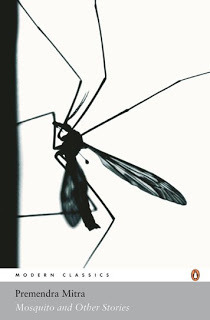
We all know an uncle who has been everywhere, met everyone, and was present at every disaster of the last fifty years — usually just before it became interesting. In Bengali literature, that uncle has a name: Ghanashyam Das, Ghana-da to everyone, and he is one of the great comic inventions of the twentieth century.
He lives in a boarding house in north Calcutta, he is middle-aged and unremarkable, and he has, according to himself, been to the bottom of the sea, the top of Everest, the middle of the Sahara and the far side of the fourth dimension. He has survived all of it, usually saving somebody important along the way.
Who was Premendra Mitra?
Premendra Mitra (1904–1988) was a Bengali poet, novelist, short-story writer, science fiction author and film director. He wrote the first Ghana-da story, Mosha (“The Mosquito”), in 1945, and kept writing them for four decades — the last one appeared in 1987, a year before he died. Mosquito and Other Stories, translated by Amlan Das Gupta and published by Penguin in 2004, collects twelve of them.
Review
If a teller of tall tales is as knowledgeable as Ghana-da, I would be delighted to listen to all the stories they have to share, even if I suspect that they were spun out of imagination. I did find Ghana-da’s need to one-up everyone and turn all discussions into monologues with him at the center a bit annoying initially, but I got used to it soon. Also, that is the whole setup for the stories.
I enjoyed the writing style and how the main character knows so much about the world. I was even fact checking some details in his stories to see if they were just random things he came up with or if they were true. This was quite an interesting and fun read. I also learnt a few random things.
The formula, in five steps
Every story runs on the same setup:
- Someone says something ordinary. The weather, a mosquito, a stone on the road.
- Ghana-da corrects them. Gently with the weariness of a man who has seen the truth and watched lesser men get it wrong.
- He begins. “That reminds me of the time…” — and the room, which has heard this before, settles in anyway.
- The tale. A specific place, a specific year, a specific piece of science or history, and Ghana-da in the middle of it, indispensable.
- The return. Someone in the room points out a flaw. Ghana-da dismisses it, insults the questioner, and the adda moves on.
The setup never varies, but it is still pleasurable since the performance is the crux.
Why it is more than a joke
Underneath the comedy, these stories are quite clever. They are travel writing about places the author has never been, in the voice of a man who has likely never been anywhere — and they are written with enough real geography, history and science that they argue with you. You cannot dismiss them because you keep almost believing them.
They are also a parody of the colonial adventure narrative: the white explorer’s memoir, with the explorer replaced by a middle-aged Bengali boarder who talks about the Amazon the way other men talk about the office. That inversion is the joke. If you can take Indiana Jones and James Bond seriously, what is stopping you from believing Ghana-da?
A note for the reader: these stories were written between 1945 and 1987, and they carry the mindset and assumptions of their time about “exotic” peoples and places. Some have not aged well.
Should you read it?
If you like tall tales, unreliable narrators, or the particular pleasure of a character who is wrong about everything and convincing about all of it, yes. If you need plot — a beginning, a middle and a resolution that means something — no. These are anecdotes, not arcs. They are best read one at a time
FAQ
Who is Ghana-da? Ghanashyam Das, a character created by Premendra Mitra in 1945. A middle-aged Calcutta boarder who tells tall tales of his impossible adventures, to a room of friends who know he is lying and listen anyway.
Do I need to read Bengali to enjoy this? No. Amlan Das Gupta’s translation is excellent, and the humour survives intact.
Is it science fiction? No/Partly. Mitra was a pioneer of Bengali science fiction, and the Ghana-da stories use real science as scaffolding for impossible adventures. They are closer to tall tales than to SF, but the science is not decoration.
How many stories are in this collection? Twelve, selected from four decades of Ghana-da stories.
Is it suitable for children? Older children will enjoy the best of them, but these are not children’s stories. They were written for adults and published in adult magazines.
Which translation should I read? I read Amlan Das Gupta’s Mosquito and Other Stories (Penguin, 2004). Lila Majumdar’s Adventures of Ghanada (National Book Trust, 1982) is the other main English selection.
Why is Ghana-da so annoying at first? Because he is written to be so. The one-upmanship is the character’s engine, and the book expects you to move from irritation to affection — which, if you are anything like me, you will.
Posts you may like:
- 10 Fictional Places Worth Visiting — Ghana-da is the patron saint of that post: a travel guide to places that do not exist
- Chekhov’s “Death of a Government Clerk” — the other short-story post; this one starts a “short stories from everywhere” thread
- How to Get Out of a Reading Slump — short stories are the fix; this is the evidence

